

Sikkim Professional University

Enquire Now & Get Course Details Instantly
Overview
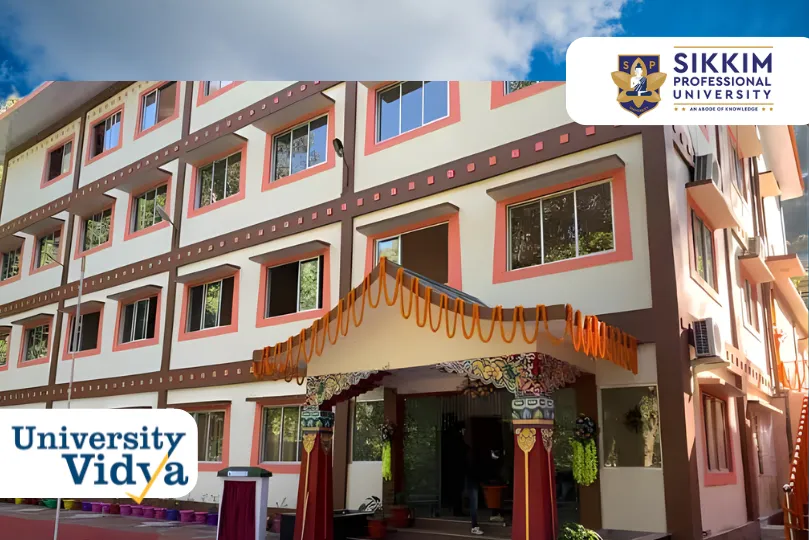
Sikkim Professional University (SPU), located at Tadong, Gangtok, East Sikkim, is one of the most established private universities in Northeast India. With a history that stretches back to 2008, SPU carries more than a decade and a half of academic experience, a notable distinction in a region where higher education infrastructure is still rapidly developing.
The university was originally founded under the name Vinayaka Missions Sikkim University through State Act No. 11 of 2008, passed by the Sikkim State Legislative Assembly. Following a comprehensive review and strategic repositioning, it was renamed Sikkim Professional University through the Amendment Act, 2020 (Act No. 09 of 2020). This renaming was not merely cosmetic; it reflected a deliberate intent to anchor the institution's identity around professional education, career readiness, and industry alignment.
Description
Quick Facts at a Glance
Detail | Information |
| University Name | Sikkim Professional University |
| Type | State Private University |
| Established | 2008 (Act No. 11 of 2008, Sikkim State Assembly) |
| Location | Sikkim |
| Programmes Offered | UG, PG, Diploma, Vocational, Ph.D (60+ courses) |
| Approvals & Recognitions | UGC | AIU | PCI | BCI | INC | SNC |
Establishment & Background
The story of Sikkim Professional University begins in 2008, a period when Sikkim was in the early stages of building its higher education infrastructure. The Sikkim State Legislative Assembly passed Act No. 11 of 2008, which brought the institution into existence as Vinayaka Missions Sikkim University. The Vinayaka Missions brand had an established presence in education across India, and this university was part of that broader educational ecosystem, serving students primarily from Sikkim and neighbouring states.
Over its first decade of operation, the university grew steadily, expanding its programme portfolio, building its campus infrastructure, and developing relationships with industry and healthcare partners. However, as higher education across India evolved under the influence of national policy reforms, the leadership recognised the need for a clearer institutional identity aligned with the practical outcomes students sought.
In 2020, through Amendment Act No. 09 of 2020, the university was formally renamed Sikkim Professional University. The name change brought a corresponding change in strategic focus, a stronger emphasis on professional programmes, career-linked curricula, and industry collaboration. Today, SPU positions itself as an institution where degree-level education is directly connected to professional competence and graduate employability.
As of its 8th Convocation, held in December 2024, SPU has produced thousands of graduates across disciplines, many of whom are working in healthcare, technology, banking, education, hospitality, and agribusiness across India and internationally. The university's alumni network continues to grow, contributing to the institution's reputation and expanding its industry connections.
Statutory Recognitions & Approvals
For any student evaluating a university, the legitimacy of its degrees is the single most important consideration. Sikkim Professional University holds a comprehensive set of statutory recognitions from India's most important regulatory bodies, ensuring that its degrees are legally valid, professionally applicable, and internationally recognised.
University Grants Commission (UGC)
SPU is recognised by the University Grants Commission the apex statutory body governing higher education in India. UGC recognition confirms that SPU has the legal authority to award degrees at undergraduate, postgraduate, and doctoral levels. Degrees from UGC-recognised universities are accepted by government departments, private employers, and public service commissions across India. This recognition is the foundational credential that makes every SPU degree valid in the eyes of Indian law.
Association of Indian Universities (AIU)
SPU is a member of the Association of Indian Universities (AIU), the nodal organisation that provides international equivalency for Indian degrees. AIU membership enables SPU graduates to have their qualifications recognised abroad by foreign universities for higher studies and by international employers for professional roles. For students who plan to work or study overseas after graduation, AIU membership is an important quality indicator.
Pharmacy Council of India (PCI)
The pharmacy programmes at SPU specifically the Diploma in Pharmacy (D.Pharm) and the Bachelor of Pharmacy (B.Pharm) are approved by the Pharmacy Council of India. PCI approval is a legal prerequisite for conducting pharmacy education in India. Without it, pharmacy graduates cannot register with state pharmacy councils or practise in clinical settings. PCI-approved pharmacy degrees from SPU therefore open doors to pharmacist registration, employment in hospitals and pharmaceutical companies, and eligibility for postgraduate pharmacy programmes at other institutions.
Bar Council of India (BCI)
SPU's law programmes carry the approval of the Bar Council of India the statutory body that regulates legal education and the legal profession in India. BCI approval is mandatory for any institution offering LL.B degrees or integrated law programmes. Graduates of BCI-approved law programmes can enrol with State Bar Councils and practice as advocates in Indian courts, making this approval essential for any aspiring legal professional.
Indian Nursing Council (INC)
The College of Nursing at SPU operates under the recognition of the Indian Nursing Council, the national statutory body governing nursing education in India. INC recognition is mandatory for nursing programmes such as B.Sc Nursing and GNM. Graduates from INC-recognised programmes are eligible to register with state nursing councils and practise as registered nurses and midwives in hospitals, clinics, and public health settings across India and abroad.
Sikkim Nursing Council (SNC)
In addition to INC recognition, SPU's nursing programmes also carry recognition from the Sikkim Nursing Council the state-level regulatory body for nursing in Sikkim. SNC recognition is particularly important for students who plan to practise nursing within Sikkim and is a sign that the university's nursing programmes meet state-specific regulatory standards.
Academic Programmes — Colleges & Faculties
Programme | Level | Duration |
| B.Tech | UG | 4 Years |
| M.Tech | PG | 2 Years |
| Diploma in Engineering | Diploma | 3 Years |
| Bachelor of Business Administration (BBA) | UG | 3 Years |
| Master of Business Administration (MBA) | PG | 2 Years |
| Bachelor of Commerce (B.Com) | UG | 3 Years |
| Master of Commerce (M.Com) | PG | 2 Years |
| Bachelor of Computer Applications (BCA) | UG | 3 Years |
| Master of Computer Applications (MCA) | PG | 2 Years |
| B.Sc Nursing | UG | 4 Years |
| Diploma in Pharmacy (D.Pharm) | Diploma | 2 Years |
| Bachelor of Pharmacy (B.Pharm) | UG | 4 Years |
Eligibility Criteria for Admission
Undergraduate Programmes
- Candidates must have passed Class 12 (10+2) from any recognised board (CBSE, ICSE, state boards).
- Minimum aggregate: 45–50% for most UG programmes. Professional programmes (B.Tech, B.Pharm, B.Sc Nursing, BPT) require minimum 50%.
- Science-based UG programmes (B.Tech, B.Pharm, BPT, B.Sc Nursing, BMLT) require 10+2 with Physics, Chemistry, and Biology/Maths as applicable.
- For BBA, BCA, B.Com, BA: Any stream in 10+2 is acceptable.
- Entrance exam scores required: JEE Main (B.Tech), NEET (health sciences where applicable), CUET (general UG), ISC or SPUEE (as specified per programme).
Postgraduate Programmes
- Candidates must hold a relevant bachelor's degree from a recognised university with a minimum of 50%.
- For MBA: Any bachelor's degree with 50%; valid CAT/XAT/MAT/GMAT/CUET-PG or SPUEE score.
- For M.Tech: Relevant B.Tech/BE with 50%; valid GATE score preferred.
- For M.Sc: B.Sc in the relevant specialisation with 50%; CUET-PG score.
- For MCA: BCA or B.Sc (Computer Science/IT) with 50%; CUET-PG.
Diploma Programmes (After 10th)
- Candidates must have passed Class 10 (SSC) from a recognised board with minimum 35–40%.
- Diploma in Engineering (Mechanical/Civil/Electrical/CSE): Class 10 with Maths and Science
Admission Process — Step by Step
- Obtain Application Form: Fill out the online admission application form with accurate academic and personal details.
- Submit Application: Complete the form with academic details, attach attested copies of required documents, and submit online or by courier/in-person.
- Entrance Exam / Merit Assessment: Provide valid CUET/JEE/NEET/GATE or SPUEE scores as applicable to your programme.
- Merit List & Selection: The university prepares a merit list based on academic performance and entrance exam scores. Selected candidates are notified and called for document verification.
- Document Verification: Submit original documents for verification. Pay the first instalment of fees (by demand draft or online payment) to confirm your seat.
- Enrolment & Classes Commence: Once admitted, collect your student ID, academic schedule, and orientation details. Classes begin per the academic calendar.
Documents Required at Admission
- Class 10 Mark Sheet and Passing Certificate
- Class 12 Mark Sheet and Passing Certificate
- Bachelor's Degree and All Semester/Year Mark Sheets (for PG applicants)
- Valid Entrance Exam Score Card (CUET / JEE / NEET / GATE / SPUEE, as applicable)
- Caste/Category Certificate (for SC/ST/OBC candidates)
- Domicile/Residence Certificate
- Passport-sized Photographs (recent)
- Government Photo ID Proof (Aadhaar Card / Voter ID / Passport)
Scholarships & Financial Assistance
SPU recognises that the financial dimension of higher education is a significant concern for many students, particularly those from economically weaker sections or from remote areas of Sikkim and the Northeast. The university has instituted scholarship programmes aimed at making quality professional education accessible to deserving students.
Scholarship categories at SPU include merit-based scholarships (for students with outstanding academic records), need-based scholarships (for students from economically disadvantaged backgrounds), and achievement-based support (for students who have excelled in sports, arts, or community service). Students from Sikkim and the Northeast who belong to Scheduled Tribe (ST) and Scheduled Caste (SC) communities may also be eligible for state and central government scholarship schemes, which SPU facilitates through its student services office.
Infrastructure & Campus Facilities
Academic Infrastructure
- Dedicated science and technology laboratories for engineering, pharmacy, nursing, allied health, and computer science
- Modern computer labs equipped with current software tools and high-speed internet
- A central library with physical collections, e-journals, and multi-format digital resources
- Seminar halls and conference rooms for academic events and guest lectures
- Smart classrooms with audio-visual and multimedia teaching tools
Student Welfare & Campus Life
- Separate hostel facilities for male and female students (both campuses)
- Canteen and food services on campus
- Medical and health services for students
- Sports facilities supporting both indoor and outdoor activities
- Student clubs and societies catering to academic, cultural, and recreational interests
- 24/7 security with anti-ragging measures and an active Anti-Ragging Committee
- Student Grievance Redressal mechanisms
- Equal Opportunity Cell and support for differently-abled students
Who Should Consider Sikkim Professional University?
Sikkim Professional University is a well-suited choice for students who are looking for a UGC-recognised private university with a broad programme portfolio, multiple statutory approvals (PCI, BCI, INC, SNC), and a proven record of over 16 years of higher education delivery in the Northeast. Its dual-campus presence across East and West Sikkim makes it geographically accessible to students from across the state.
The university is particularly strong in health science programmes nursing, pharmacy, physiotherapy, and allied health where its professional council approvals (INC, SNC, PCI) give graduates a direct pathway to professional registration. For students from Sikkim, Darjeeling, and the wider Northeast, it represents a locally accessible option for professional education at fee levels that are generally more affordable than comparable institutions in metropolitan centres.
FAQ's
1. Is Sikkim Professional University recognized by AIU?+
2. Is Sikkim Professional University good for working professionals?+
3. Is Sikkim Professional University a government or private university?+
4. Are Sikkim Professional University degrees valid for jobs and higher studies?+
5. Is Sikkim Professional University UGC approved?+
Get in Touch
Our Faculty
The university has a group of skilled and knowledgeable professors who are dedicated to providing students with top-notch academic programs. The faculty at Jain Online University includes professionals with extensive backgrounds in teaching, research, and industry. They are leaders in their fields. They use cutting-edge teaching techniques to engage students and make sure they understand the concepts being taught while bringing their extensive knowledge and experience to the classroom.
Get Real Career Advice From Experts at University Vidya.